Eppur binaria non é esclusa: Gaia astrometry does NOT disfavor a binary origin for Long Secondary Periods
P. Iwanek1,Piotr A. Kołaczek-Szymański1,2, D.M. Skowron1, G. Pojmański1, I. Soszyński1
1Astronomical Observatory, University of Warsaw, Al. Ujazdowskie 4, 00-478 Warsaw, Poland
2 Astronomical Institute, University of Wrocław, Mikołaja Kopernika 11, 51-622 Wrocław, Poland
Abstract
Abstract:
We present an independent reassessment of the nearby long secondary period (LSP) stars analyzed by Shariat 2026.
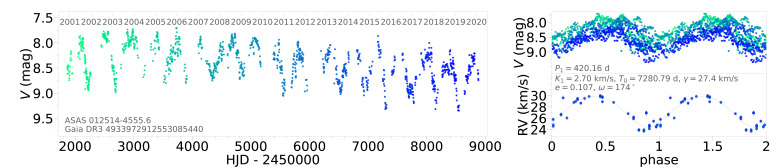
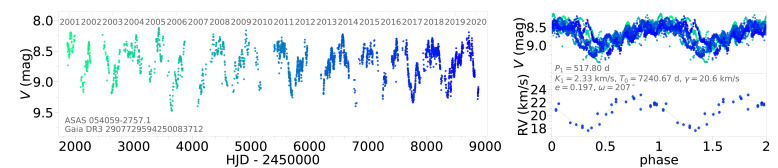
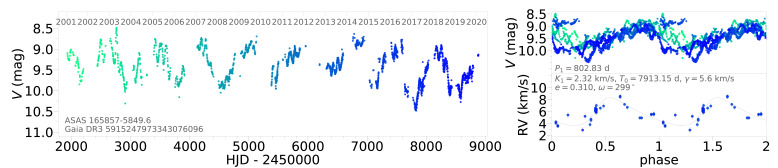
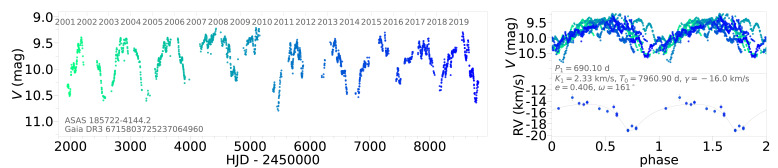
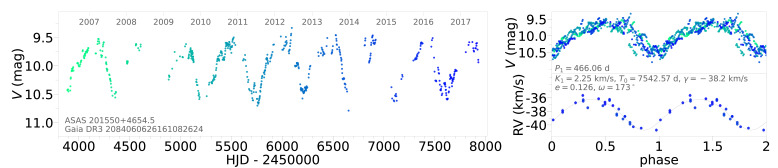
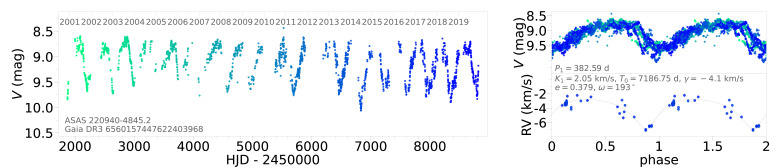
By inspecting long-term All Sky Automated Survey (ASAS) light curves, together with Gaia Focused Product Release (Gaia FPR) radial velocity (RV) curves, for 221 LSP candidates (out of 224) located within 1.5 kpc from the Sun, we find that less than half of the sample (103 objects, ~47%) exhibit convincing LSP-like behavior. The remaining part of the sample could be more naturally interpreted as that of semi-regular variables (SRVs), characterized by irregular or multi-periodic pulsations. This indicates that the analyzed sample is significantly contaminated by non-LSP objects and therefore is not representative of the classical period--luminosity sequence-D population. Using the gaiamock tool to predict Gaia renormalized unit weight error (RUWE) values for binary systems, we show that even the nearest LSP stars do not have to exhibit elevated RUWE values as a~consequence of their binarity. We also argue that the binary-nature hypothesis for LSP stars does not lead to a discrepancy between the observed and expected distance--RUWE relation for these variables.
Results
We independently re-evaluated the 221 nearby LSP candidates from the Gaia FPR using long-baseline ASAS photometry and Gaia RV data. We confirm 103 stars (47%) as genuine LSP variables, while 118 objects are more consistently classified as SRVs, demonstrating substantial contamination of the original sample. The complete classification, including periods, Gaia DR3 identifiers, RUWE values and distances, is provided in Table 1.
Our gaiamock simulations further show that even if LSP stars are binary systems, their Gaia DR3 RUWE values are not necessarily expected to exceed 1.4. For the confirmed LSPs, the simulated RUWE distributions remain predominantly below this threshold, including for the nearest objects. Thus, the absence of elevated RUWE does not provide a robust argument against a binary origin of LSP variability.
The ASAS V-band light curves used in the classification are also available for download as a tar.gz archive
The full paper is available as a preprint through arXiv (https://arxiv.org/abs/2606.05292), with the published version in The Astrophysical Journal (ApJ) available here:
https://iopscience.iop.org/article/10.3847/1538-4357/ae876c