
The largest star that changed its face
An international team of scientists has published in the prestigious journal Nature Astronomy the results of many years of research on one of the largest known stars in the Universe. Located in a neighboring galaxy, the Large Magellanic Cloud, the star WOH G64 has undergone a complete transformation over the surprisingly short timescale of just a few years.
From a Red Supergiant to a New Type of Stellar System
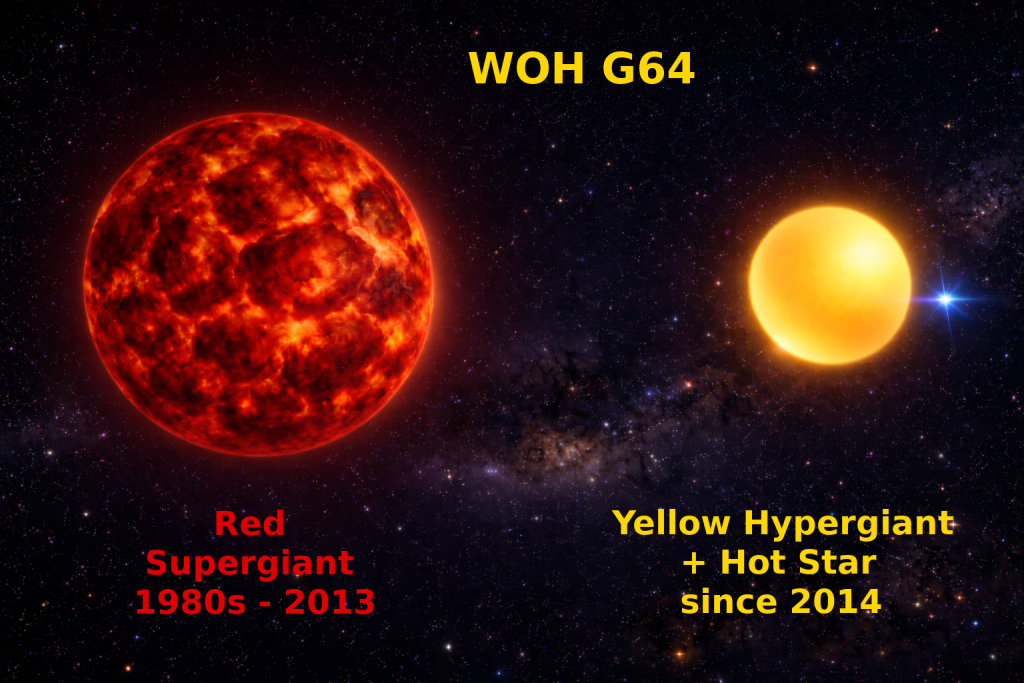
WOH G64 was discovered in the 1980s. It soon became clear that it was a massive, extremely cool star of nearly record-breaking size, with a radius exceeding 1,500 times that of the Sun. Such rare objects are known as red supergiants. Massive stars have relatively short lifespans – lasting only several million years – and the red supergiant phase represents the final stage of their evolution. According to stellar evolution theory, such stars should soon end their lives by exploding as supernovae or collapsing into black holes without a visible explosion. However, these final evolutionary stages remain poorly studied observationally.
WOH G64 has been photometrically monitored over the past decades, including since the beginning of this century by the Polish OGLE survey. During the project’s third phase (2001–2009), astronomers detected regular periodic variations in the star’s brightness, caused by pulsations similar to those of Mira-type stars but with an unusually long period of 886 days. The star was included in the OGLE Collection of Variable Stars under the name OGLE-LMC-LPV-06819.
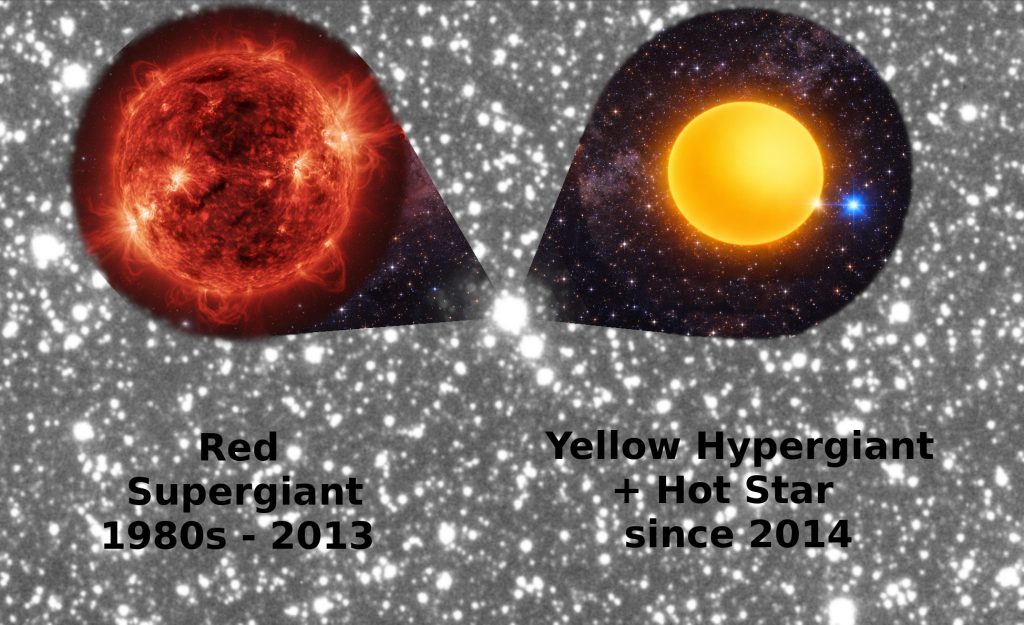
The star was also observed spectroscopically from time to time. Toward the middle of the last decade, researchers found that its spectrum had undergone dramatic changes – WOH G64 now looks completely different from how it appeared 20 years ago. Its surface temperature increased by about 1,000 K. Continuous photometric observations during the fourth phase of the OGLE project (since 2010), supplemented by data from other surveys, revealed that the previously observed periodic variability had disappeared. They also showed a drastic change in the star’s color, consistent with the temperature increase. The turning point came around 2011, when the star’s brightness suddenly declined. When it returned to its former luminosity in 2013–2014, it had revealed a new identity.
Spectacular Transformation
Instead of exploding as a supernova, the star evolved from a cool red supergiant into a so-called symbiotic star – a binary system consisting of a yellow hypergiant (still enormous but significantly hotter than before) and a gravitationally bound companion. This companion is a Sun-like star, though several times more massive, hotter, and brighter than our Sun, emitting primarily blue light. The yellow hypergiant is nearly half the size of its previous incarnation as a red supergiant. As these observations demonstrate, the late stages of stellar evolution can follow different paths.
What Could Have Caused Such a Radical Transformation?
Two scenarios seem plausible.The first is related to the system’s binary nature. As the envelope of the more massive star expanded, the companion eventually became engulfed beneath its surface, causing the system to appear externally as a single, bloated red supergiant. This stage is known as the common-envelope phase in binary evolution. Interaction between the engulfed star and the envelope of its massive companion likely triggered the ejection of the outer layers. By the early 2010s, the original binary system had re-emerged – now visible as a blue star and a yellow hypergiant, the latter representing the exposed inner layers of the former red supergiant.
The alternative scenario assumes that the yellow hypergiant expelled enormous amounts of mass some time ago. This ejected material may have obscured the entire binary system for many years, making it appear as a red supergiant. In the early 2000s, the surrounding matter dispersed sufficiently for WOH G64 to reappear in its original form as a symbiotic system—a blue star paired with a yellow hypergiant.
What is the system’s future?
Its exact fate remains uncertain, but the massive component will most likely explode as a supernova. Another possibility is that the system will ultimately form a black hole – either through the gravitational collapse of the hypergiant in a later stage of its evolution or as a result of a merger with its blue companion.
WOH G64 offers a unique opportunity to observe, in real time, the late stages of massive star evolution and the crucial role binarity can play in shaping this process. Continued observations in the coming decades will undoubtedly deepen our understanding of how massive stars evolve.
The study of WOH G64 also highlights the importance of large-scale surveys monitoring millions of stars, such as the OGLE project. Such long-term observations make it possible not only to discover rare and remarkable objects like WOH G64, but also to track their previously unknown behaviors over increasingly long timescales.
Publication in Nature Astronomy
The paper describing the research results on the WOH G64 system was published in the journal Nature Astronomy: “The dramatic transition of the extreme Red Supergiant WOH G64 to a Yellow Hypergiant,” Gonzalo Muñoz-Sanchez, Maria Kalitsounaki, Stephan de Wit, Konstantinos Antoniadis, Alceste Zoe Bonanos, Emmanouil Zapartas, Konstantina Boutsia, Evangelia Christodoulou, Grigoris Maravelias, Igor Soszyński, Andrzej Udalski, 2026, Nature Astronomy.
We warmly congratulate our researchers on this remarkable discovery and invite you to read the full article to learn more!