Menu
Instytut
O obserwatorium
Wiadomości
Wydarzenia
Seminaria
Seminaria wtorkowe
Statistics Journal Club
Pracownicy
Pracownicy naukowo-dydaktyczni
Pracownicy naukowo-techniczni i administracyjni
Wspomnienia
Ważne dokumenty
Rada OAUW
Skład
Terminy i porządki obrad
Protokoły
Rada Naukowa Dyscypliny Astronomia
Stacja Badawczo-Dydaktyczna w Ostrowiku
Jednostki
Katedra Astrofizyki Obserwacyjnej
Katedra Astrofizyki Teoretycznej
Biblioteka
Stopnie naukowe
Postępowania habilitacyjne
Postępowania doktorskie
Poczta mailowa
Zamówienia publiczne
Badania
OGLE
ASAS
POLNA
Projekty prowadzone
z udziałem OA UW
H.E.S.S.
CTA
LIGO/VIRGO
Planck
Gaia
Lista publikacji
Linki
Czasopisma astronomiczne
Acta Astronomica
Astronomical Journal
Astronomy & Astrophysics
Ann. Rev. Astron. & Astrophys.
Astrophysical Journal
Astrophysical Journal Letters
MNRAS
Sky & Telescope
PASP
PASJ
JRASC
Nature
Nature Astronomy
Science
Rocznik astronomiczny
Astro-ph
IAU Circulars
The Astronomer’s Telegram
GCN Circulars
SIMBAD
NASA ADS
Web of Science
Scopus
Astronomy Picture of the Day
STScI Digitalized Sky Survey
Granty MEiN
Dla pracowników
Bieżące informacje dla pracowników
Oferty zatrudnienia
Studia
Kierunek Astronomia
Bieżące informacje
Plan zajęć
Proseminaria studenckie
Koło Naukowe Astronomów UW
Oferty stypendialne
Studenckie praktyki astronomiczne w Ostrowiku
Doktorat
Informacje ogólne
Lista doktorantów
Rekrutacja 2026
Archiwum rekrutacji
Rekrutacja 2025
Rekrutacja 2024
Rekrutacja 2023
Rekrutacja 2022
Rekrutacja 2021
Czas i
Pogoda
Szukaj
Szczegóły seminarium
Nie odnaleziono seminarium o podanej dacie!
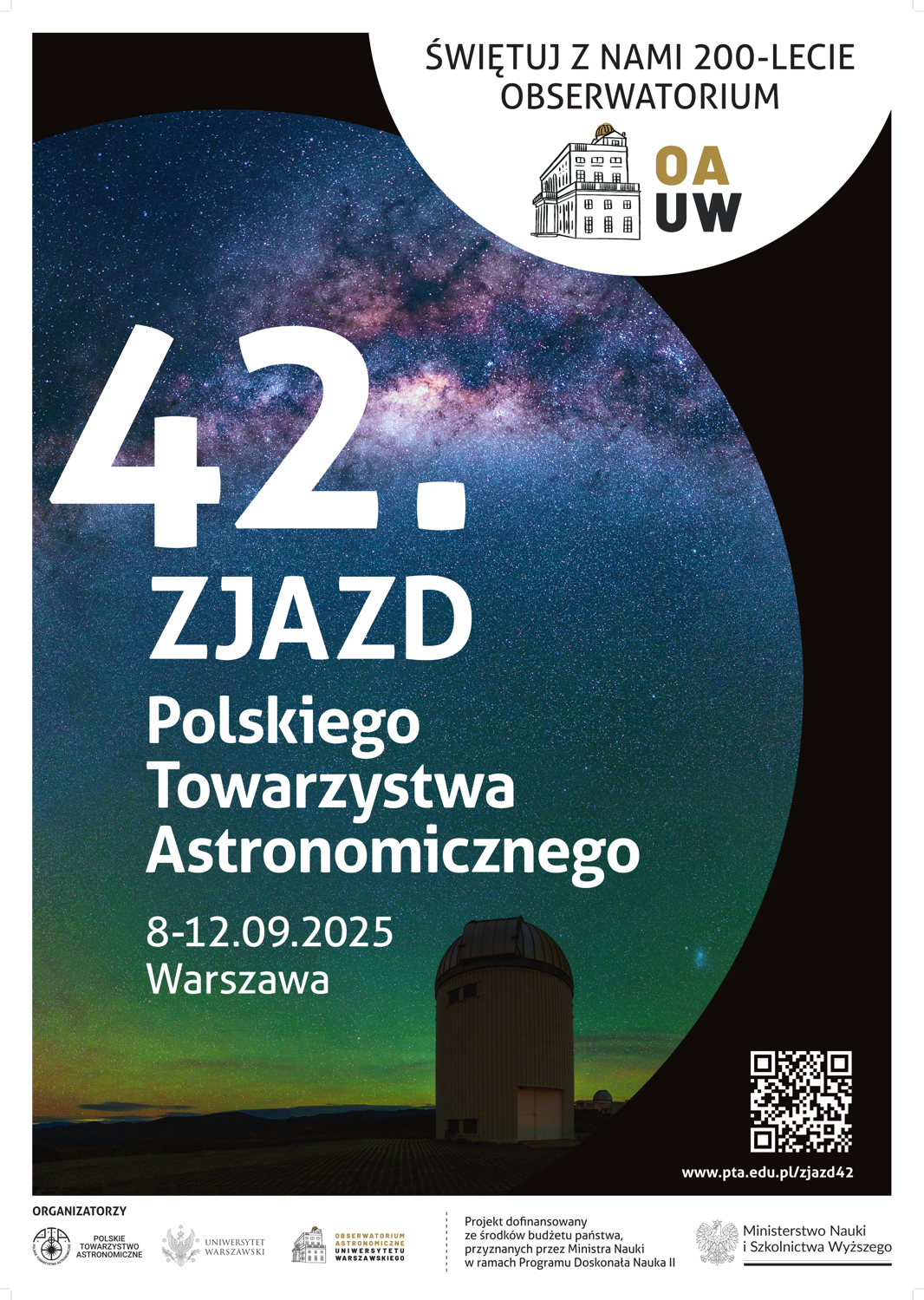
Obchody 200-lecia istnienia OAUW
Seminaria wtorkowe
Andrzej Zdziarski (CAMK PAN,WAW)
TBD
Szczegóły
27.10.2026
Felipe Espinoza (CAMK PAN, WAW)
TBD
Szczegóły
3.11.2026
Nada Ihanec (ING,ES)
TBD
Szczegóły
17.11.2026
Niedawne publikacje
Revealing Limitation in the Standard Cosmological Model: A Redshift-dependent Hubble Constant from Fast Radio Bursts
Kalita, Surajit; Uniyal, Akhil; Bulik, Tomasz
et al.
The Astrophysical Journal
,
996
,
50
Published: 2026-01
Constraining lens masses in moderately to highly magnified microlensing events from Gaia
Pylypenko, U.; Wyrzykowski, Ł.; Mikołajczyk, P. J.
et al.
Astronomy and Astrophysics
,
705
,
A24
Published: 2026-01
Detection of disk-jet coprecession in a tidal disruption event
Wang, Yanan; Lin, Zikun; Wu, Linhui
et al.
Science Advances
,
11
,
25.9068
Published: 2025-12
Jakość badań naukowych i kształcenia
Astronomia na UW uzyskała w Ewaluacji Jednostek Naukowych 2026
Kategorię A+
Polska Komisja Akredytacyjna nadała Astronomii na UW certyfikat
Doskonały Kierunek
Uniwersytet Warszawski w 2026 roku zajął pierwsze miejsce w
rankingu kierunku studiów
astronomia
przygotowanym przez miesięcznik
Perspektywy
Finansowanie badań
Przejdź do treści
Otwórz pasek narzędzi
Ułatwienia dostępności
Ułatwienia dostępności
Zwiększ test
Zwiększ test
Zmniejsz tekst
Zmniejsz tekst
Odcienie szarości
Odcienie szarości
Wysoki kontrast
Wysoki kontrast
Odwrócony kontrast
Odwrócony kontrast
Jasne tło
Jasne tło
Podkreślenie linków
Podkreślenie linków
Czytelna czcionka
Czytelna czcionka
Resetuj
Resetuj
Mapa witryny
Mapa witryny
Na stronach internetowych Obserwatorium Astronomicznego UW stosowane są pliki „cookies” zgodnie z
polityką prywatności.
Zgoda